
Suite 1300
Salt Lake City, UT 84111
Block-1 3rd Floor, Perungudi Bypass Rd, Perungudi,
Chennai - 600096
MGR Main Rd,
Perungudi, Chennai - 600096
Villupuram,
Tamil Nadu – 605602
Inpatient Coding Services
AI Inpatient Coding to Maximize DRG Accuracy & Eliminate Revenue Leakage
Inpatient coding drives hospital revenue. Each stay is a DRG-based event where diagnosis sequencing, CC/MCC capture, and ICD-10-PCS coding determine outcomes. Errors lead to loss.
Scope of services
Full-spectrum inpatient coding : every case type, every clinical service line
Inpatient Coding Is a Financial Imperative, Not an Administrative Function
Inpatient coding operates differently from every other coding domain. Coders do not code individual services or procedures in isolation. They analyze the complete medical record, apply complex sequencing rules, validate documentation against clinical criteria, assign principal and secondary diagnoses with CC/MCC impact assessment, code all reportable procedures in ICD-10-PCS, and group the encounter into the DRG that determines full claim payment.
One missed CC or MCC directly reduces DRG weight. One incorrect principal diagnosis changes the DRG group entirely. One undocumented procedure leaves a higher-complexity DRG unachievable. These are not billing errors. They are revenue events, and they happen on every claim where coding accuracy falls short of documentation quality.
What AnnexMed Codes: Diagnosis, Procedure, and Specialized Services?
Diagnosis & DRG Coding
- ICD-10-CM Principal Diagnosis Coding
- Secondary Diagnosis & Comorbidity Capture
- CC / MCC Identification & Validation
- MS-DRG Assignment & Optimization
- APR-DRG Grouping & Severity Scoring
- POA Indicator Assignment
- Discharge Disposition Coding
- LOS & Readmission Documentation
Procedure & Surgical
- ICD-10-PCS Procedure Coding
- High-Acuity & Complex Surgical Coding
- Cardiovascular & Cardiac Surgery
- Orthopedic & Spine Procedure Coding
- Neurosurgery & Cranial Procedures
- Transplant & Organ Procurement Coding
- Obstetric Delivery & Neonatal Coding
- Trauma & Critical Care Procedures
Specialized Services
- Concurrent Inpatient Coding
- Pre-Bill Quality Checks & Validation
- DRG Optimization & Variance Review
- CDI Query Support & Response Coding
- ICD-10-CM/PCS Training & Education
- Coding Compliance Audit Support
- Complex Comorbidity Case Coding
- Queried Diagnosis Capture & Coding
Why it's complex?
Why inpatient coding is the most complex and highest-stakes coding function in healthcare?
Full Chart Review Required
Principal Diagnosis Sequencing
The UHDDS definition governs which diagnosis is listed first. A sequencing error does not just mislabel the claim, it changes the MDC, the DRG grouper path, and the reimbursement category entirely.
CC/MCC Capture & Impact
ICD-10-PCS Procedure Coding
Advanced DRG Grouper Logic
POA Indicator Requirements
Present-on-Admission indicators affect hospital-acquired condition designation, quality metrics, and CMS payment adjustment. Incorrect POA assignment creates audit exposure independent of DRG accuracy.
Annual ICD-10-CM/PCS Updates
The Financial Impact of DRG Errors: What Inpatient Coding Errors Cost Your Hospital
DRG miscoding is not a compliance problem. It is a revenue problem that compounds across every case, every payer, and every reporting period.
Coding Error
Direct Financial Impact
Downstream Consequence
DRG
misclassification
Full claim underpayment, entire stay reimbursed at the wrong DRG weight
Permanent revenue loss risk; no automatic recovery mechanism
Missed
CC/MCC
DRG downgrade to base DRG without complexity adjustment
Reduced overall case mix index; weakened payer contract benchmarking accuracy
Incorrect principal
diagnosis
Wrong MDC assignment; claim enters incorrect DRG grouper path
RAC audit risk; potential recoupment and compliance exposure
ICD-10-PCS
procedure error
Surgical DRG fails to reflect procedure performed
Claim may not meet medical necessity for higher-complexity DRG
POA indicator
errors
Hospital-acquired condition designation triggers non-payment
CMS payment adjustment; quality metric impact; star rating effects
Documentation
gaps uncoded
Comorbidities not captured do not contribute to DRG
CMI understated vs. actual patient acuity across the service line

Performance benchmarks our hospital clients consistently achieve
These results are measured across active hospital and health system inpatient coding engagements — not projections. Our clients see verifiable, quantifiable improvement in the metrics that matter most to hospital finance and revenue cycle leadership.
The AnnexMed difference
Inpatient coding built for audit defensibility, DRG accuracy, and integrity

IP-Certified AHIMA Coders
All inpatient coders hold CCS, RHIA, or RHIT credentials with IP experience. Assignments align to facility type, service line, and case complexity before accounts go live.
Structured Pre-Bill Quality Audit
All inpatient encounters undergo structured pre-bill review validating MS-DRG, CC/MCC capture, POA indicators, discharge status, and ICD-10-PCS accuracy before UB-04 submission.
RAC, MAC & OIG Audit Support
During inpatient audits, our compliance team delivers complete coding rationale, query trails, DRG support documentation, and appeal assistance to protect hospital reimbursement.
Concurrent Coding & Real-Time CDI Collaboration
Concurrent inpatient coding reviews are coordinated with CDI and clinical teams, enabling real-time queries, physician tracking, and documentation completion before discharge.
ICD-10-CM/PCS Compliance & Annual Updates
Our coders complete annual ICD-10-CM and ICD-10-PCS update training, AHA Coding Clinic reviews, and CMS IPPS education to stay current with changes affecting hospital reimbursement.
HIPAA Compliance & SOC 2 Certification
All inpatient coding workflows, PHI handling, and file transfers comply with HIPAA Privacy and Security rules. We maintain SOC 2 certification and execute BAAs before engagement.
AI DRG Analysis & Revenue Visibility
AnnexMed’s AI analyzes DRG patterns, CC/MCC capture, CMI trends, and gaps to detect revenue leakage before submission. It flags anomalies and supports coders with DRG-level insights.

Inpatient coding drives DRG revenue.
What coding gaps are costing you right now?
AnnexMed serves the full spectrum of inpatient hospital environments, from independent critical access hospitals managing low-volume, high-complexity cases to multi-hospital health systems requiring standardized, scalable inpatient coding infrastructure across dozens of facilities.
Facility Type
Clinical Complexity Addressed
Key Specializations
Acute Care Hospitals
Full inpatient coding across medical, surgical, and complex cases with MS-DRG and APR-DRG expertise. Coding capability for high-volume environments.
MS-DRG, APR-DRG, High-Acuity
Critical Access
Hospitals (CAH)
CAH-specific inpatient coding for cost-based reimbursement, cost report impact, swing bed coding, and rural health billing complexity.
CAH Cost-Based, Rural Health, Low Volume
Academic Medical
Centers
Complex case mix, resident documentation variability, and teaching physician attestation rules managed without DRG accuracy compromise.
GME Compliance, Complex Cases
Long-Term Acute
Care (LTACH)
LTACH PPS coding including high-acuity diagnosis capture, ventilator documentation, interrupted stay rules, and patient criteria validation.
LTACH PPS, Interrupted Stay, Ventilator
Inpatient Psychiatric
Facilities (IPF)
IPF PPS coding with accurate principal psychiatric diagnosis selection, comorbidity capture, and ECT procedure documentation.
IPF PPS, Psychiatric DRGs, Behavioral Health
Inpatient Rehabilitation Facilities (IRF)
IRF-PAI aligned coding including impairment group code assignment, tier classification, and comorbidity capture for CMS compliance.
IRF PPS, Impairment Group Codes, CMG
Pediatric Hospitals
& NICU
Pediatric DRG structures, neonatal coding complexity, and documentation nuances that distinguish pediatric cases from adult inpatient.
Pediatric DRGs, Neonatal, NICU
Multi-Hospital
Health Systems
Standardized coding protocols, centralized quality oversight, and enterprise-level reporting on CMI, DNFB, and denials across all facilities.
System Standards, Enterprise Reporting, Scalable
Inpatient coding that connects to every revenue cycle function
CDI
Integration
Denial
Management
IP coding accuracy data feeds directly into denial root-cause analysis, preventing recurrence of DRG-based denials, medical necessity rejections, and CC/MCC documentation failures across payers.
DNFB & Accounts
Receivable
Accurate, timely inpatient coding compresses DNFB and accelerates clean UB-04 submission, reducing aged AR balances and improving cash flow predictability for hospital finance leadership.
CMI & Financial
Reporting
DRG assignment accuracy drives case mix index, which influences payer contract benchmarking, service line profitability analysis, and strategic capacity planning at the CFO and executive leadership level.
Quality &
Value-Based Care
How we execute?
Annexmed inpatient coding execution workflow
Every inpatient engagement follows a structured, repeatable workflow from medical record receipt through final coded claim submission. The workflow is consistent across all facility types, with service-line-specific protocols layered within each step.
Medical Record Receipt
Electronic record retrieval from your EHR or HIM system. Records are queued by discharge date, priority status, and DNFB age. Coders are matched to case type before queue assignment.
Full Chart Review
Coders conduct complete record review, H&P, progress notes, operative reports, lab and imaging findings, medication records, and nursing documentation, before assigning any codes.
AI-Assisted DRG Suggestion
AnnexMed’s AI analyzes records to suggest a preliminary DRG, with diagnosis and procedure code recommendations, CC/MCC flags, and documentation alerts for accurate coding.
Coder Validation & Assignment
IP-certified coders validate AI suggestions, apply clinical judgment, resolve documentation gaps via CDI queries, and assign final ICD-10-CM/PCS codes with POA indicators for assignment.
Pre-Bill Quality Audit
QA review thoroughly validates MS-DRG, CC/MCC accuracy, POA, discharge status, and procedure code completeness. DRG variance cases are promptly escalated for senior coder review.
Final Coded Claim Submission
Completed coding is returned to your system for UB-04 generation and claim submission. Turnaround time, DNFB reduction targets, and filing deadlines are tracked against agreed SLAs.
Performance benchmarks
Results our hospital clients consistently achieve
45%
Reduction in Operational Coding Costs
32%
Reduction in
DNFB Accounts
72%
Productivity
Improvement
36%
Reduction in
Aged AR
Getting started
Flexible inpatient coding structures built around your hospital's needs
Full IP Coding Outsourcing
Concurrent Coding Program
Hybrid Coding Support
DNFB Backlog Resolution
Scalable FTE & Flex Staffing
Frequently Asked Questions
Case Studies
See the impact we deliver
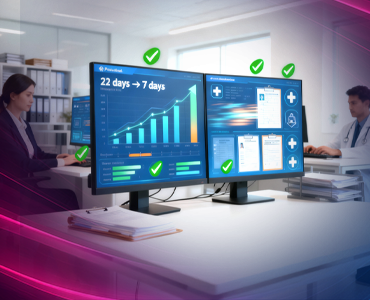
Discover how AnnexMed reduces denials, accelerates reimbursements, and strengthens financial performance. Backed by measurable outcomes and proven RCM expertise, we deliver operational excellence, revenue stability, and sustainable growth you can trust.

Client Voices
See how our clients succeed

Dr. Kenneth Walsh

Sandra Mitchell
Dr. David Mercer
Proven RCM expertise. Delivered at scale.
For over 20 years, AnnexMed has delivered RCM solutions nationwide, combining expert billing, coding, and AR support to drive measurable results and growth.
- 20+ years of proven healthcare RCM experience
- 1,500+ professionals supporting billing, coding & AR
- 500+ certified coders across multiple specialties
- 99%+ compliance with HIPAA and security standards
- All 50 states served with consistent, scalable operations
